

Real-Time Industrial Monitoring Is More Than a Dashboard
Seeing what’s happening is not the same as knowing what action to take.
When a pump overheats, pressure drops unexpectedly, or a motor begins showing abnormal behavior, collecting sensor data is only the first step.
The real challenge is turning that data into reliable, actionable operational intelligence.
This is where Event-Driven Architecture and Microsoft Fabric Real-Time Intelligence offer interesting possibilities.
From Industrial Data to Operational Intelligence
A modern industrial monitoring architecture can connect equipment telemetry with real-time data processing, analytical capabilities, and operational decision-making.
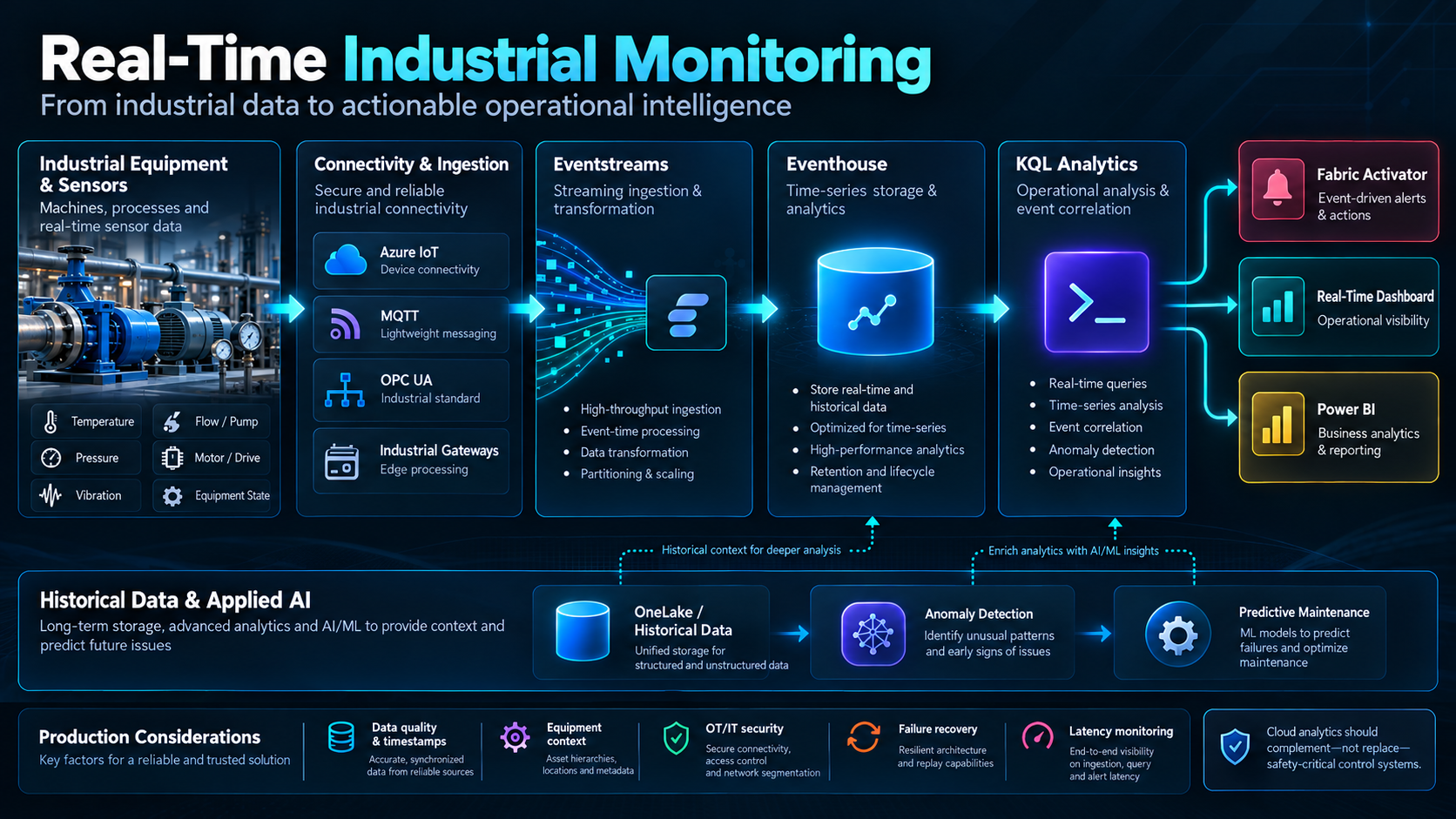
The following architecture illustrates a possible data flow:
Industrial Equipment → Azure IoT → Eventstreams → Eventhouse → KQL Analytics
[Insert Industrial Real-Time Monitoring Architecture Diagram Here]
Within this architecture, several Microsoft technologies support different operational requirements:
- Fabric Activator: Supporting event-driven alerts and automated responses to defined conditions.
- Real-Time Dashboards: Providing visibility into equipment behavior and operational conditions.
- Power BI: Connecting equipment-level insights with broader business intelligence and performance analytics.
Together, these technologies provide a foundation for moving beyond traditional monitoring dashboards.
However, connecting technologies is only part of the engineering challenge.
Three Principles That Matter Most
1. Trustworthy Data
Speed without reliability has limited operational value.
Data quality, accurate timestamps, and equipment context are essential for meaningful analytics.
Industrial monitoring solutions must ensure that incoming data is consistent, interpretable, and sufficiently reliable to support operational decisions.
2. Actionable Intelligence
A dashboard shows what’s happening.
A well-designed monitoring system helps engineers understand what matters, detect abnormal conditions, and determine when action may be needed.
The objective is not simply to visualize more information, but to transform incoming data into meaningful operational insights.
3. Production Reliability
Industrial environments introduce requirements beyond those of conventional analytics applications.
These include:
- Secure OT/IT integration
- Failure recovery and system resilience
- End-to-end latency monitoring
- Scalable data ingestion and processing pipelines
- Reliable event handling and alerting
Cloud-based analytics should complement—not replace—safety-critical industrial control systems.
Beyond Monitoring: Applied AI and Predictive Maintenance
Historical operational data and Applied AI can extend real-time monitoring toward anomaly detection and predictive maintenance.
By combining real-time telemetry with historical equipment behavior, organizations can explore opportunities to identify emerging failures, improve maintenance planning, and reduce unplanned downtime.
However, predictive models must be properly validated before their outputs can be trusted in operational decision-making.
Final Perspective
The future of industrial monitoring isn’t about collecting more data.
It’s about engineering trustworthy systems that connect industrial operations, real-time analytics, and intelligent decision-making.
This is an area I’m actively exploring at the intersection of Data Engineering, Industrial IoT, and Applied AI.
Join the Discussion
What do you see as the biggest challenge in industrial real-time analytics: integration, data quality, or operational reliability?
Technical Reference
Microsoft Learn — Predictive Maintenance Reference Architecture